Friday, 16 December 2011

Flat Plans

Here are some rough sketches of what I would like for my front cover, contents page and my double page spread. The sketches show Where the text will go, and where the images will go, layout etc.

Front Cover:

Contents Page:

Double Page Spread:

Shots I might use...

I have drawn some shots of what I might use for my front cover, contents page and dps.
There are two images for each section...


Tuesday, 13 December 2011

Editorial Profile

This is my editorial profile, explaining the purpose of the magazine, and the benefits to the people who buy the magazine.
This is a questionnaire I designed, that I sent out to my target audience, the results of this, will help me to plan what will be best for my music magazine  Questionnaire
View more documents from JessicaCantell
Risk Assesment
View more presentations from JessicaCantell.

This is my risk assessment for my photoshoot, I will be taking the photos in a room, most probably a classroom, so I have listed all the possible risks, and their solutions.

Tuesday, 6 December 2011

Magazine Deconstructions

Advantages and Disadvantages of a questionnaire

A questionnaire can be a very helpful way of getting real peoples opinions on your ideas.
However one of the disadvantages is that although you are putting in options you have chosen, you could have a particular vision for your magazine which might not be voted the favourite option, therefore meaning you would have to compromise to go with the most popular vote.
Also, another disadvantage with a questionnaire is that the people who fill it in, may not be filling it in with valid information, for example, they could fill in an answer for a joke, which would mess up the final result of the questionnaire.
With all these disadvantages, it is still a very good way of researching peoples opinions, without you having to guess what they might like. Most of the time, it is accurate, and reliable information that you can use to adapt and use to make your magazine interesting for the target audience.

Research

This is a montage I did, showing my favourite parts of different music magazines that are around at the moment, gathering a collection of these examples will help a lot to decide what to do with my magazine.
These are the results of the most important questions on my questionnaire that I did. The results show the favourite name for the magazine, the artists and colours as well. This information will help a lot when it comes to deciding certain parts of my magazine. 

Monday, 5 December 2011

Customer Profile

This is Louise Wilson, she is a 18 year old student from the UK and enjoys listening to Dance and Electropop music. In her spare time, Louise enjoys visiting friends, and going shopping, she also likes going to gigs, and regularly follows her favourite artists which range from Basement Jaxx to Lady Gaga. She also downloads a lot of music from Itunes.
Louise also regularly buys music magazines, however she feels there aren't enough magazines representing the genre she likes best.
She says she likes to be given a free gift with the magazine, like a free download or poster, as it makes it worth the price.

Audience Theory

Hypodermic Needle Theory - The belief that people receive information directly without any intervening variable, as in a vacuum

Two Step Flow Theory - Marketing strategy based on the theory that non-personalmarketing messages are first passed to an opinion leaderbefore being passed to the individual consumer.Organizations who believe this theory base their marketing strategy on reaching the opinion leaders instead of the individual consumer.

Uses & Gratification Theory - An active audience theory that focuses on ‘what people do with the media’ rather than what the media does to people, arguing that audiences are free to pick and choose from a wide range of media products to satisfy their own needs.

Audience Reception Theory - Reception theory is a version of reader response literary theory that emphasizes the reader's reception of a literary text. It is more generally called audience receptionin the analysis of communications models. In literary studies, reception theory originated from the work of Hans-Robert Jauss in the late 1960s. It was most influential during the 1970s and early 1980s in Germany and USA (Fortier 132), amongst some notable work in Western Europe. A form of reception theory has also been applied to the study of historiography; see Reception history (below).
Cultural theorist Stuart Hall is one of the main proponents of reception theory, having developed it for media and communication studies from the literary- and history-oriented approaches mentioned above. This approach to textual analysis focuses on the scope for "negotiation" and "opposition" on the part of the audience. This means that a "text"—be it a book, movie, or other creative work—is not simply passively accepted by the audience, but that the reader / viewer interprets the meanings of the text based on their individual cultural background and life experiences. In essence, the meaning of a text is not inherent within the text itself, but is created within the relationship between the text and the reader.
Stuart Hall also developed Hall's Theory of encoding and decoding, focusing on the communication processes at play in the televisual form.
Reception theory has since been extended to the spectators of performative events, predominantly theatre. Susan Bennett is often credited with beginning this discourse within theatre. Reception theory has also been applied to the history and analysis of landscapes, through the work of landscape historian John Dixon Hunt, motivated by recognition that the survival of gardens and landscapes is due to their public reception.

Tuesday, 1 November 2011

Examples Of Music Videos...

When I was trying to find some ideas/inspiration for my magazine, I found a few music videos that show the style I want to have very well. Mainly because of the colours and style the music videos have.

Willow Smith - Whip My Hair:
This music video has the main colour ideas that I thought of for my magazine. With the plain grey/white background, and then the bold, bright colour coming in, this is the style I was hoping to have.

It is the same with this next music video, as it has again a plain white setting, but there are also bursts of colour throughout the video. I like the idea of this, as it is interesting and eye-catching, which I think is very important.

Robyn - Cobrastyle
These two videos show really well what I am hoping the colour scheme for my magazine will be. They are very simple, but very effective too.

Thursday, 13 October 2011

Deconstruction of magazine front cover 1

gttThis is the front cover for an issue of the music magazine Q. You can very clearly see the masthead featured in the left hand corner which stands out and catches your attention, and instantly lets the reader know which magazine they are looking at. 
The main image is of Liam Gallagher, and although there is no direct eye contact, the image still connects with the audience, as his body language is very straight on and direct, and the camera angle is a medium close up. Also in his sunglasses you can see the rest of his new band members, this suggests to the reader that this is what he is now focusing on, and therefore lures them in, as they would want to know more. It also shows all the band members in an artistic and unique way, also making it stand out on the shelf, and drawing the reader in.
As well as a strong cover image, this front cover also draws the reader in, as they have used a couple of lures, one being the "Queen 16-page exclusive", making the reader want to buy this magazine so they can have this information. They have also worded their cover lines so that they too sound like something exclusive you could only find out in this magazine.
Some examples of the mode of address are in the cover lines, where a lot of informal language has been used. One writes, "Booze, fags and... muffins!" Connecting with the reader, as they feel it may be a more enjoyable read, without complicated and confusing words included.
Overall, this magazine cover brings across a futuristic feeling, of things that will be happening in time to come. This is because of the colours used. As well as the consistent red, black and white that you will always see with Q magazine, they have used simple, but effective greys. Also the expression and body language makes it look like they are looking onward  and that Liam is focused on his new band, this feeling helps to draw the reader in, as they will want to know more about it.

Wednesday, 12 October 2011

Mood board for my music magazine

This is my mood board for my music magazine.
The genre I have chosen is Dance/Electropop. I chose this genre as it is appealing to me, and I think this leaves a lot of flexibility with the style. 


As you can see, I have included lots of colour points throughout the mood board. This is similar to what I want on my magazine. I love some of the photos I have chosen, because they have dull, or plain backgrounds, then they have included a colour that is supposed to stand out, either on the text, or another part of the image. I really like the cover for Mixmag, and the way they have used colour on their front cover. 


My target audience for my magazine, would be young people, more specifically 12 - 30 year olds, these are the people would would most likely enjoy this genre of music, as this age group go to clubs/concerts where they would mostly play this genre, or they would be the people who buy this genre of music.

I ♥ S F - Magazine Front Cover


For the preliminary task, we were asked to create the front page for a school/college magazine.


To help us achieve the right photo for our magazines, we had Alex Walton come in to give us an introduction into techniques for taking photos, and getting the right shot. He is a photographer who works for Archant.


He spoke about all the different things you have to consider to get a really good photo for a magazine cover and I learned a lot. 
One thing that I learned was that most magazines have the name of the magazine on the left hand side of the cover, this is so that when it is stacked on the shelf, the name won't be hidden to potential customers. Therefore when we took our photo, we made sure that there was a reasonable space along the left hand side of the photo, so that we could add any text, and the title to the cover.


To make our magazine stand out, I used the bold red boxes to highlight the text with the magazine features, however it doesn't take away from the main image. 
The reason we chose this image out of all the others we had taken, was because it showed the school element with the text books piling up, but also because it shows the stress a 6th form student might be going through. With the facial expressions and the fact there are a lot of books in this shot, helps to draw the target audience in, as they can relate to it, and therefore would want to read the magazine.
We also wanted to try to make it appealing to the age group, with an interview with the current artist Wretch 32, who would be inspiring and helpful with the information included. This lures the audience in, as well as the competition we have included where you can win an Ipad 2.

Wednesday, 21 September 2011

Photographs

For the task, we had to take a selection of photos for the school magazine cover. Depending on what we wanted the magazine to feature, we had to chose a section of the school, eg. science to take a photo from. We thought that science would be appealing to the students in younger years, as there is a lot of variety within the subject, which would give us a lot of flexibility. We wanted the photo to portray someone who was really enjoying the subject, with a lot of excitement so that it would be eyecatching to the audience.
I have included a few of the photographs we took...

This is one of the first ones we did, the lighting has worked very well in this shot, as it is highlighting her very well, and all together it is a good photo.
However the only issue we had with it, was that it was just a regular photo, and she looks happy, but not quite excited enough for what we had wanted on the magazine cover.
We needed someone who looked like they were doing something really exciting within science, for example, an experiment for the first time to encourage students to read the magazine. We had wanted to have maybe even a comical element to the photograph to make it not seem like a dull school magazine.


This image however, was the opposite. The face expression, and body position would  have been perfect for what we wanted on our magazine cover, but with this shot, the lighting is not as good as the first image, and the other person in the picture draws attention away from the main focus, meaning we would have to cut around him, which would mean a lot of extra work, and might not look very professional.

After experimenting with these few photos, I know now that we need to make sure everything is set up right before we try to take the photo, like the background, the lighting, and so on.
We will, try to combine both aspects of the photos, so that we will hopefully end up with a better looking photo, that is just what we had wanted to end up with.

Tuesday, 20 September 2011

Preliminary Task

Using DTP and an image manipulation program, produce the front page of a new school/college magazine, featuring a photograph of a student in medium close-up plus some appropriately laid-out text and a masthead. Additionally candidates must produce a mock-up of the layout of the contents page to demonstrate their grasp of DTP.

Friday, 16 September 2011

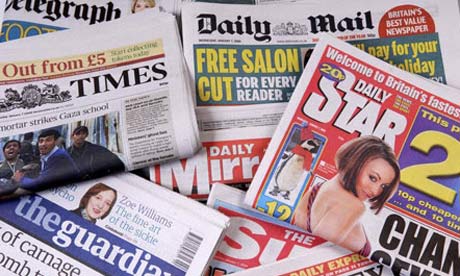
What is media?


The media is a way of communicating to the public, in a very modern way, so to keep up to date with the things going on in the world.
It reaches out to a large number of people, and is consumed in peoples homes through the new technology available.

Web 2.0 is a term used to describe the new world wide web, and the way it is changing. It allows ordinary people to share and create media, and to interact through social networking sites, such as blogs, wikis, news feeds, etc.


Mediation is the way a media text could stand for an issue, an idea, an event and so on. It shows how things change as a result of the media.
Saturation in the media, is when we are constantly shown and fed media texts, eg. adverts and newspapers etc. 


The media is strictly regulated in countries such as Burma, China and Ethiopia, so that the government can control ideas and give the citizens in their countries their own messages, and use the media in a positive way to show themselves in a good light.


The term, "media products are shared" Means really that because of the mass audience a media text receives, it becomes part of our everyday lives, in the way that we speak, and in the things that we do, so even people that don't associate themselves with certain media texts, they will still know to a degree, catch phrases and sayings related to the texts. Eg. television catch phrases.

Media convergence means when different types of media come together, for example, the television, music, and news papers used to be very seperate forms of media, however now you can get access to all these things on say, the internet.

The media is very important in todays society, because it is a very important type communication, sending out different messages to us, and informing us on news, imformation etc.
If we didn't have the media, then we wouldn't be so far advanced in society generally, in technologies, and opinions, and so on.